
The pelvic tilt is one of the first exercises many healthcare providers and physical therapists recommend for people with lower back pain. Although it looks simple, this gentle movement teaches you how to control the position of your pelvis and activate the deep muscles that support your spine.
Many people with back pain unknowingly move primarily through their lower back instead of using their abdominal and hip muscles. The pelvic tilt helps retrain these movement patterns, improving spinal stability while reducing unnecessary strain on the lumbar spine.
Because it is low-impact and easy to modify, the pelvic tilt is appropriate for many beginners and often serves as the foundation for more advanced core strengthening exercises.
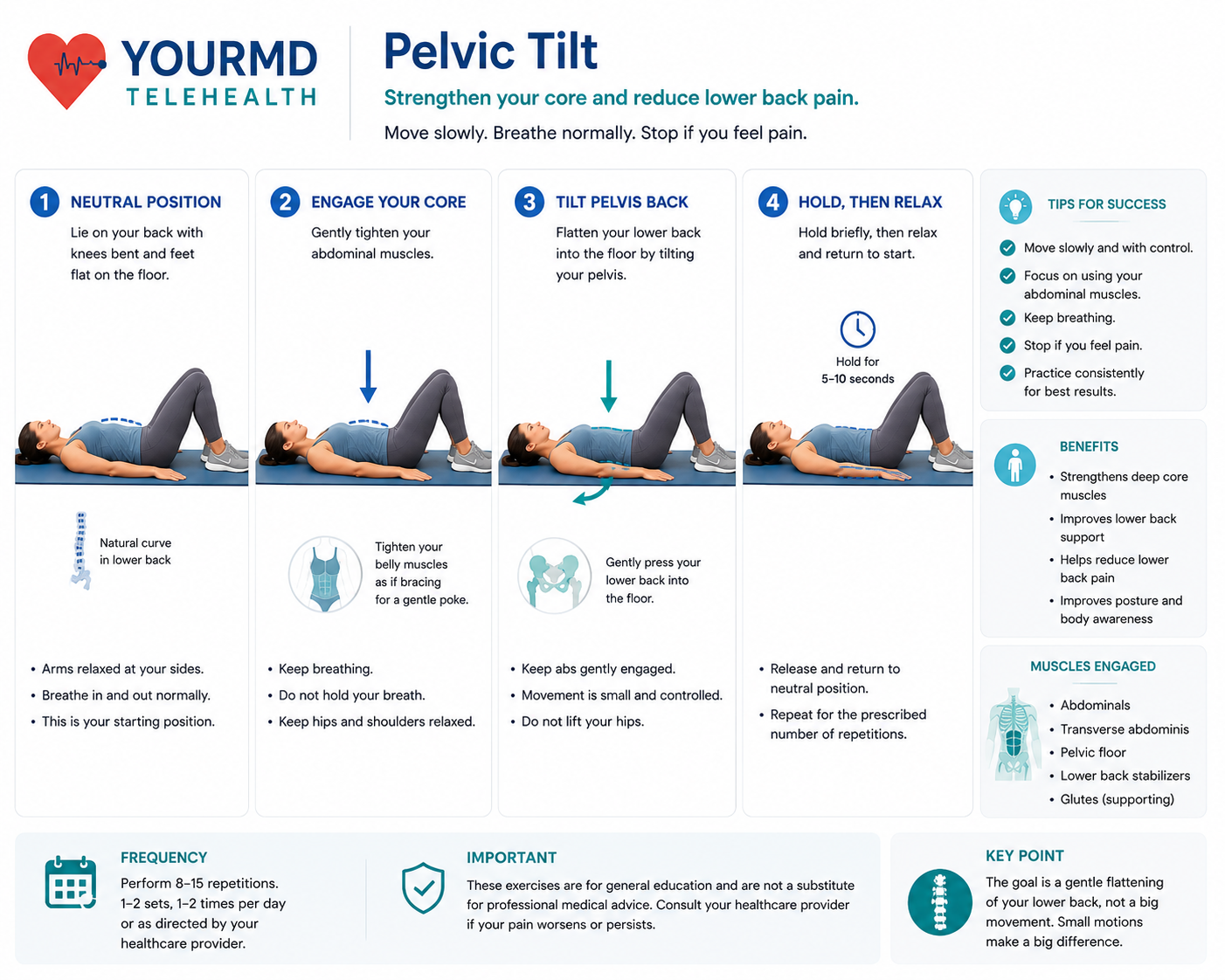
Benefits of the Pelvic Tilt Exercise
When performed correctly, the pelvic tilt may help strengthen the deep abdominal muscles, improve spinal stability, increase awareness of pelvic position, reduce lower back stiffness, improve posture, prepare your body for more advanced exercises, improve coordination between your core and hip muscles, and reduce strain on the lumbar spine during daily activities. The pelvic tilt focuses on quality of movement rather than strength alone.
What Muscles Does the Pelvic Tilt Work?
Deep abdominal muscles — the transverse abdominis acts like a natural brace around your abdomen, helping stabilize your spine. Pelvic floor muscles — these support the pelvis and work together with your core during movement. Gluteal muscles — assist with pelvic control and stability. Multifidus muscles — small muscles along the spine that contribute to spinal stability.
Learning to activate these muscles together helps create a stronger, more stable foundation for everyday movement.
Who May Benefit?
The pelvic tilt is commonly recommended for people with acute or chronic lower back pain, core weakness, muscle tightness, poor posture, prolonged sitting during the day, recovery after a back strain, and early rehabilitation following an episode of back pain. It is also commonly included in programs designed to improve core strength before returning to sports or other physical activities.
When Should You Avoid This Exercise?
Stop the exercise and contact your healthcare provider if it causes sharp back pain, pain that radiates farther down your leg, increasing numbness, new weakness, severe dizziness, or significant hip pain.
Seek medical evaluation before beginning if you have a recent spinal fracture, recent spinal surgery without medical clearance, severe osteoporosis with new back pain, loss of bowel or bladder control, numbness around the groin or saddle area, or severe back pain after major trauma.
Starting Position
- Lie on your back.
- Bend both knees and place your feet flat on the floor about hip-width apart.
- Rest your arms comfortably at your sides.
- Relax your shoulders.
- Allow your lower back to rest in its natural position.
There will usually be a small space between your lower back and the floor. This is normal.
Step-by-Step Instructions
Step 1: Find a neutral spine
Take a slow breath and notice the natural curve in your lower back. Do not force your back flat before beginning.
Step 2: Tighten your core
Gently tighten your abdominal muscles as though preparing for a gentle tap to your stomach. Avoid sucking in your abdomen or holding your breath. The contraction should feel firm but comfortable.
Step 3: Flatten your lower back
Slowly rotate your pelvis backward by tightening your abdominal muscles. Your lower back should gently press into the floor. The movement is subtle — avoid pushing forcefully.
Step 4: Hold the position
Maintain the position for 5 to 10 seconds. Continue breathing normally. You should feel your abdominal muscles working without straining.
Step 5: Return to neutral
Slowly relax your muscles and allow your pelvis and lower back to return to their natural resting position. Avoid releasing the movement quickly.
Step 6: Repeat
Perform 10 to 15 repetitions, 1 to 3 sets, resting briefly between sets if needed.
Breathing During the Exercise
Exhale as you flatten your lower back; inhale as you return to the starting position. Steady breathing improves muscle coordination and helps prevent unnecessary tension.
Common Mistakes to Avoid
- Using too much force. The pelvic tilt is a small movement — trying to flatten your back as hard as possible does not improve the exercise.
- Holding your breath. Breathing should remain slow and relaxed.
- Pushing with your feet. The movement should come from your abdominal muscles and pelvis.
- Lifting your hips. Unlike a glute bridge, your hips should remain on the floor.
- Rushing through repetitions. Control is more important than speed.
Easier Modifications
If you have difficulty feeling the movement: begin with very gentle pelvic movements and let awareness build; hold each repetition for only two or three seconds before gradually increasing; or start with 5–8 repetitions and increase gradually as your endurance improves.
More Challenging Progressions
Once you've mastered the pelvic tilt, you can progress to exercises such as the Dead Bug, Bird Dog, Glute Bridge, Marching Bridge, Heel Slides, and Modified Plank. Each of these builds upon the core control developed during the pelvic tilt.
How Often Should You Do Pelvic Tilts?
For most people: daily or every other day, 10 to 15 repetitions, 1 to 3 sets. Because the exercise is gentle, it is often appropriate to perform more frequently than higher-intensity strengthening exercises.
Can Pelvic Tilts Help Sciatica?
Sometimes. If poor spinal control contributes to your symptoms, improving core stability may help reduce stress on irritated structures. However, if the exercise increases leg pain, numbness, or tingling, stop and discuss your symptoms with your healthcare provider.
Can Older Adults Perform Pelvic Tilts?
Yes. The pelvic tilt is an excellent introductory core exercise for many older adults because it places minimal stress on the joints while improving spinal control. It can also be modified for people with limited mobility.
Can You Perform Pelvic Tilts During Pregnancy?
Pelvic tilts are commonly included in prenatal exercise programs, particularly during the early stages of pregnancy. However, prolonged exercises performed flat on your back are generally not recommended after the first trimester, because the weight of the uterus may reduce blood flow in some positions. If you are pregnant, speak with your obstetric healthcare provider before beginning or continuing this exercise.
Frequently Asked Questions
Should I feel this exercise in my stomach?
Yes. Most people feel the exercise primarily in the deep abdominal muscles. You may also notice mild activation in your glutes and pelvic muscles.
Should my hips lift off the floor?
No. Your hips remain in contact with the floor throughout the movement. If your hips lift, you're performing a glute bridge instead.
Can I do pelvic tilts every day?
Yes. Many people perform pelvic tilts daily as part of their rehabilitation or core strengthening routine.
How long does it take to see improvement?
Many people notice improved body awareness within days. Meaningful improvements in core strength generally occur over several weeks of consistent practice.
When Should You Contact Your Healthcare Provider?
Contact your healthcare provider if the exercise consistently worsens your symptoms, pain spreads into your leg, you develop numbness or weakness, your symptoms interfere with normal daily activities, or you're unsure whether this exercise is appropriate for your condition.
Seek Immediate Medical Care If
Seek emergency medical attention immediately if you experience loss of bowel or bladder control, numbness around the groin or saddle area, significant weakness in one or both legs, severe back pain following major trauma, fever or chills accompanied by severe back pain, or sudden severe back pain with abdominal pain, dizziness, or fainting.
The Bottom Line
The pelvic tilt is a simple but highly effective exercise for improving core activation, spinal stability, and pelvic control. Although the movement is small, learning to engage your deep abdominal muscles can reduce unnecessary stress on your lower back and provide the foundation for more advanced strengthening exercises.
Practice the movement slowly, breathe normally, and focus on quality rather than force. As your control improves, pelvic tilts can be combined with exercises such as the Bird Dog, Glute Bridge, and Dead Bug to build a stronger, healthier back.