
If you've experienced lower back pain, you've probably wondered whether exercise will help—or make it worse.
The answer is that the right exercises can be one of the most effective treatments for lower back pain. While resting for a day or two after an injury may be appropriate, prolonged inactivity often leads to increased stiffness, weaker muscles, and slower recovery.
Strengthening the muscles that support your spine can reduce stress on your back, improve posture, increase stability, and lower the risk of future episodes of pain. The goal isn't to "push through" pain. Instead, it's to build strength gradually using controlled, low-impact movements.
Why Strength Matters
Your spine depends on many muscles for support: deep abdominal muscles, back muscles, gluteal muscles, hip muscles, and pelvic muscles. When these muscles become weak, your spine may have to work harder during everyday activities such as standing, lifting, walking, and climbing stairs. Improving strength helps distribute forces more evenly throughout your body and supports healthier movement patterns.
Before You Begin
Exercise is generally safe for most people with uncomplicated back pain, but you should avoid exercising if you have severe or rapidly worsening pain, new leg weakness, loss of bowel or bladder control, numbness around the groin, fever associated with back pain, or a recent major injury until you've been evaluated. If you're unsure whether exercise is appropriate, speak with your healthcare provider or physical therapist.
General Exercise Tips
- Move slowly and focus on proper technique.
- Breathe normally — avoid holding your breath.
- Stop if pain becomes sharp or significantly worse.
- Start with one set and increase gradually as tolerated.
Quality of movement is far more important than the number of repetitions.
1. Pelvic Tilt
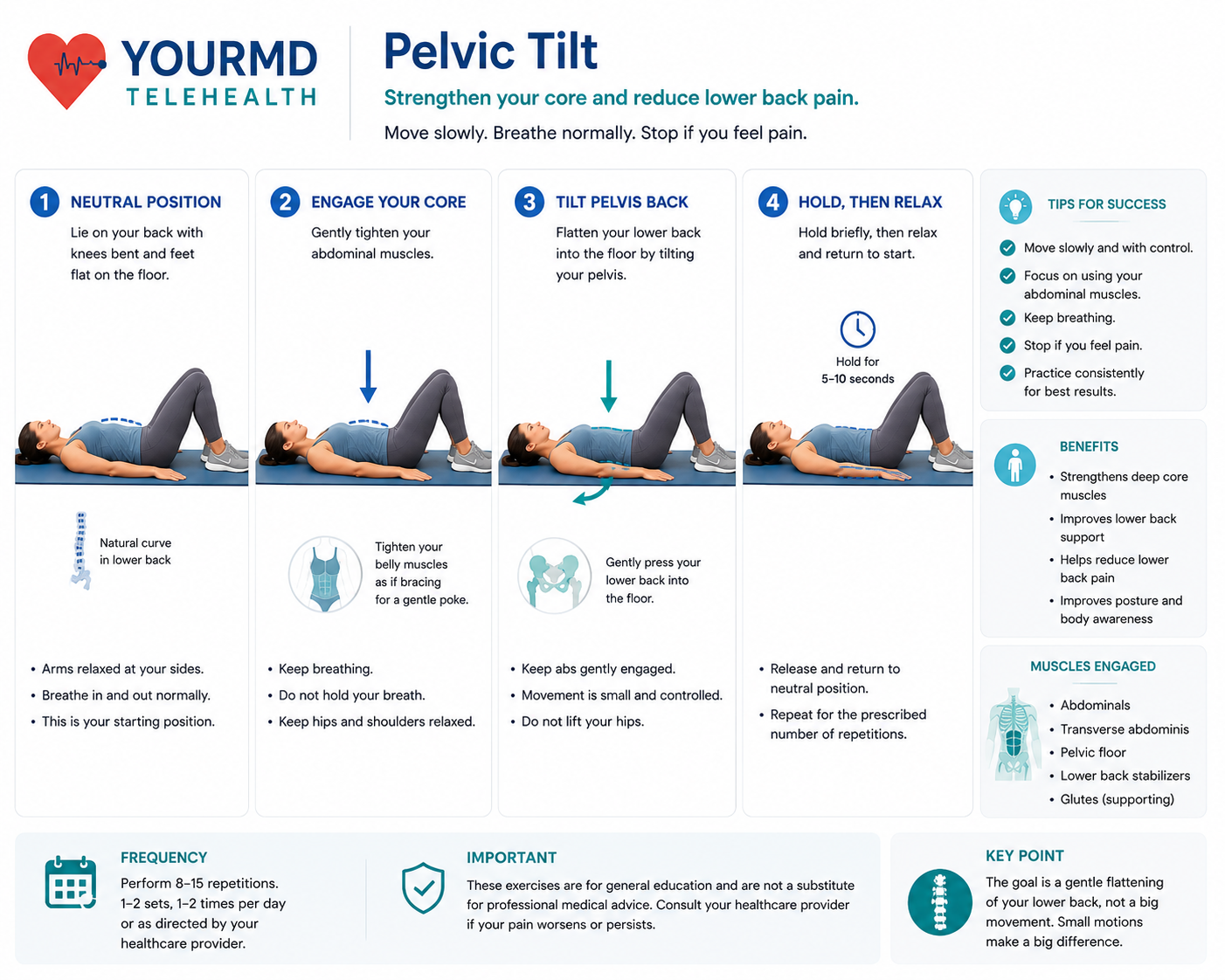
The pelvic tilt teaches gentle control of the lower back and activates the deep abdominal muscles. Lie on your back with knees bent, tighten your abdominal muscles, flatten your lower back gently into the floor, hold five seconds, relax, and repeat 10–15 times. It improves core activation, supports spinal stability, and reduces stiffness. Full technique in our pelvic tilt guide.
2. Glute Bridge
Strong glute muscles reduce stress on the lower back during standing and walking. Lie on your back with knees bent and feet hip-width apart, tighten your abdominal muscles, lift your hips until your shoulders, hips, and knees form a straight line, hold three to five seconds, and lower slowly. Repeat 10–15 times. See the full glute bridge guide.
3. Bird Dog
Bird Dog improves balance, coordination, and core stability. Begin on your hands and knees, tighten your abdominal muscles, extend one arm forward while extending the opposite leg backward, keep your hips level, hold five seconds, and switch sides. Repeat 8–10 times per side. See the full Bird Dog guide.
4. Dead Bug
The Dead Bug strengthens the deep abdominal muscles while maintaining a neutral spine. Lie on your back, raise your arms toward the ceiling, lift your hips and knees to about 90 degrees, slowly lower one arm and the opposite leg, return, and alternate sides for 8–10 repetitions per side. It activates deep core muscles, improves trunk control, and protects the lower back during movement.
5. Side Plank (Modified)
This exercise strengthens the muscles that stabilize the spine from the sides. Lie on your side with knees bent, support yourself on your forearm, lift your hips off the floor, keep your body in a straight line from shoulders to knees, hold 10–20 seconds, and lower with control. Repeat 3–5 times per side.
6. Wall Sit
Wall sits strengthen the legs and hips while minimizing movement through the spine. Stand with your back against a wall, slide down until your knees are partially bent, keep your back supported, hold 10–30 seconds, and return to standing. Repeat 5–10 times.
7. Clamshell
The clamshell targets the hip muscles that help stabilize the pelvis. Lie on your side with knees bent and feet together, lift the top knee while keeping your pelvis still, lower slowly, and repeat 10–15 times before switching sides. It strengthens hip stabilizers, improves pelvic alignment, and reduces strain on the lower back.
8. Standing Hip Hinge
Learning to bend properly protects your back during everyday lifting. Stand with feet shoulder-width apart, place your hands on your hips, push your hips backward, keep your back straight, and return to standing. Repeat 10–15 times. It reinforces proper lifting mechanics and reduces stress on the lumbar spine.
9. Partial Squat
Partial squats strengthen the hips and legs while improving functional movement. Stand with feet shoulder-width apart, bend your knees slightly while pushing your hips backward, keep your chest upright, and return to standing. Perform 10–15 repetitions.
10. Walking
Walking may not seem like an exercise program, but it's one of the best activities for many people with back pain. Walking improves circulation, reduces stiffness, maintains mobility, supports weight management, and promotes recovery. Start with 5–10 minutes if needed and gradually increase your time as your symptoms improve.
How Often Should You Exercise?
For most people: strengthening exercises 2–3 days per week, walking most days of the week, and gentle stretching daily. Allow your muscles time to recover between strengthening sessions. As you become stronger, gradually increase the number of repetitions or the amount of time you hold each exercise.
Common Mistakes to Avoid
Avoid exercising through severe pain, holding your breath, moving too quickly, ignoring proper form, progressing too rapidly, and returning to heavy lifting before rebuilding strength. Recovery is usually more successful when you increase activity gradually.
When Exercise May Need to Be Modified
Some conditions require individualized exercise programs — for example, herniated discs, sciatica, spinal stenosis, osteoporosis, pregnancy, and recent spinal surgery. Your healthcare provider or physical therapist can recommend modifications that fit your diagnosis and goals.
Frequently Asked Questions
Should I exercise if my back hurts?
For many people, yes. Gentle strengthening exercises often improve recovery and reduce future episodes of back pain.
How long does it take to notice improvement?
Many people begin noticing improvements after several weeks of consistent exercise, although recovery varies depending on the underlying cause and the severity of symptoms.
Is walking enough?
Walking is an excellent foundation, but combining it with strengthening and stretching exercises generally provides better long-term results.
Can exercise prevent future back pain?
Regular exercise cannot prevent every episode, but maintaining strong core, hip, and back muscles significantly reduces the risk of recurrent lower back pain for many people.
When Should You Contact Your Healthcare Provider?
Contact your healthcare provider if exercise consistently worsens your symptoms, pain lasts longer than several weeks, you develop numbness or tingling, you notice weakness in your legs, or you are unsure which exercises are appropriate for your condition. A physical therapist can also help develop a personalized exercise program.
Seek Immediate Medical Care If
Seek emergency medical attention immediately if you develop loss of bowel or bladder control, numbness around the groin or saddle area, significant or rapidly worsening leg weakness, severe back pain after a major fall or accident, fever or chills associated with severe back pain, or sudden severe back pain with abdominal pain, dizziness, or fainting.
The Bottom Line
Exercise is one of the most effective non-surgical treatments for uncomplicated lower back pain. Strengthening the muscles that support your spine can reduce pain, improve stability, restore normal movement, and lower your risk of future episodes.
Begin with gentle, controlled exercises such as Pelvic Tilts, Glute Bridges, Bird Dogs, and Walking. Focus on proper technique rather than intensity, and increase your activity gradually as your symptoms improve. Building a stronger core and healthier movement habits takes time, but consistency is one of the best investments you can make in your long-term spine health.