
The Bird Dog is one of the most effective exercises for improving core strength and spinal stability. It is commonly recommended by physical therapists, sports medicine physicians, and spine specialists because it strengthens the muscles that support your back while placing relatively little stress on the spine.
Unlike exercises that involve repeated bending or twisting, the Bird Dog teaches your body to stabilize the spine while your arms and legs move. This is an important skill for everyday activities such as lifting groceries, climbing stairs, carrying children, and getting out of a chair.
The exercise may look simple, but performing it with proper technique requires balance, coordination, and control. For many people recovering from lower back pain, quality is much more important than the number of repetitions.
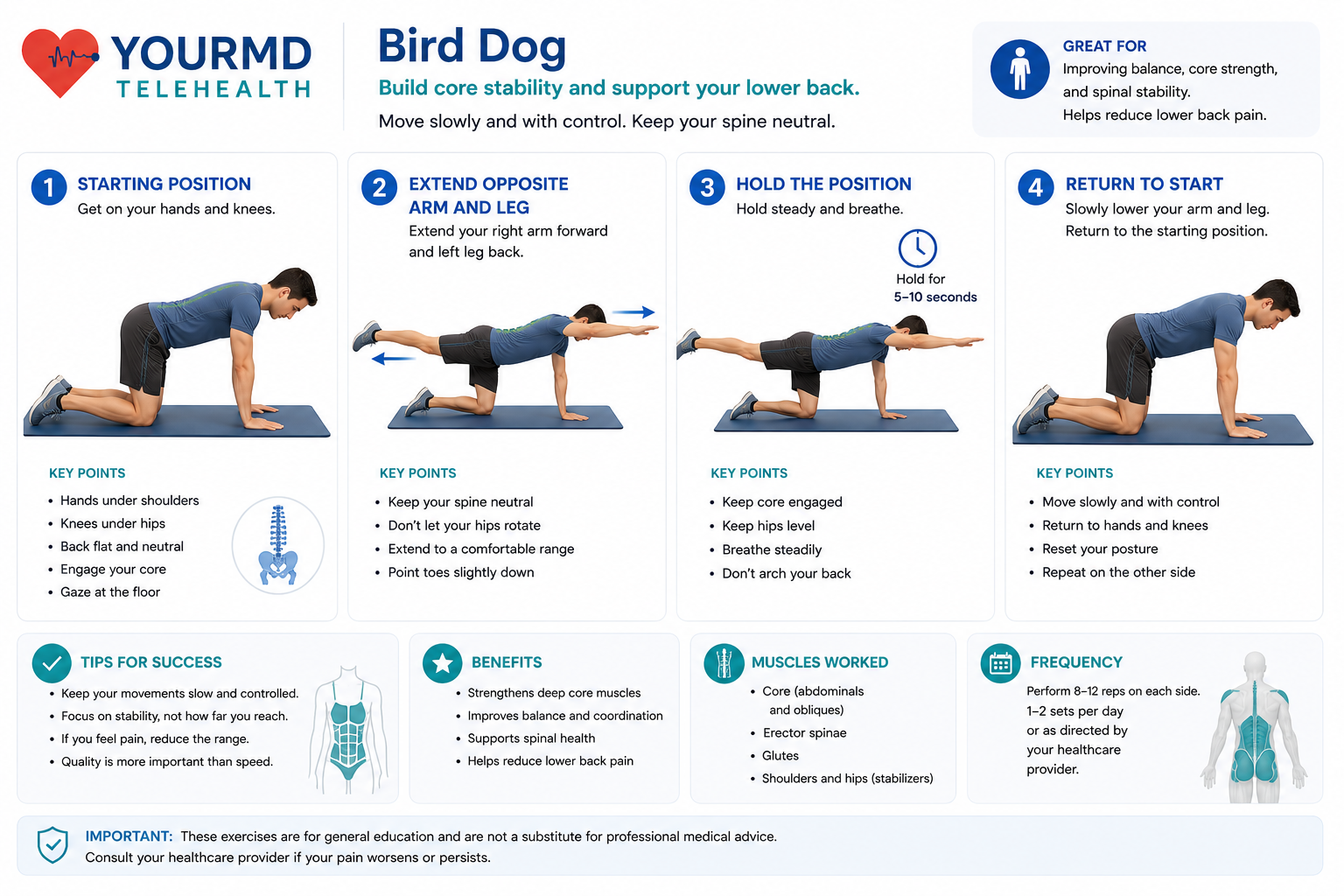
Benefits of the Bird Dog Exercise
When performed correctly, the Bird Dog may help improve core strength, increase spinal stability, strengthen the muscles that support the lower back, improve balance and coordination, strengthen the gluteal muscles, improve posture, reduce the risk of future episodes of lower back pain, and improve movement during daily activities. Because the Bird Dog emphasizes control rather than heavy resistance, it is appropriate for many beginners.
What Muscles Does the Bird Dog Work?
Core muscles — your deep abdominal muscles help stabilize the spine throughout the movement. Multifidus muscles — these small muscles run along the spine and play an important role in spinal stability. Gluteal muscles — the gluteus maximus and gluteus medius help stabilize the hips and pelvis. Shoulder stabilizers — the muscles around your shoulder blade keep your upper body steady while your arm reaches forward.
Who May Benefit?
The Bird Dog exercise is commonly recommended for people with recurrent lower back pain, mild chronic lower back pain, core weakness, poor balance, recovery after a back strain, sedentary lifestyles, and reduced spinal stability. It is often included in rehabilitation programs for athletes and older adults alike.
When Should You Avoid This Exercise?
Stop the exercise and contact your healthcare provider if it causes sharp back pain, pain radiating farther down your leg, increasing numbness, increasing weakness, loss of balance that creates a fall risk, or significant dizziness.
Seek medical evaluation before beginning if you have a recent spinal fracture, recent spinal surgery without clearance, severe osteoporosis with new back pain, loss of bowel or bladder control, numbness around the groin, or severe back pain after major trauma.
Starting Position
- Begin on your hands and knees.
- Place your hands directly beneath your shoulders.
- Position your knees beneath your hips.
- Spread your fingers comfortably.
- Tighten your abdominal muscles gently.
- Keep your neck in a neutral position by looking at the floor.
Imagine balancing a glass of water on your lower back — the goal is to keep your trunk as steady as possible. If kneeling is uncomfortable, place a folded towel beneath your knees.
Step-by-Step Instructions
Step 1: Brace your core
Before moving, gently tighten your abdominal muscles. Do not hold your breath — continue breathing normally throughout the exercise.
Step 2: Extend one leg
Slowly straighten one leg behind you. Lift it only until it is roughly level with your hips. Avoid lifting it too high.
Step 3: Extend the opposite arm
Reach the opposite arm forward with your thumb pointing upward. Reach only as far as you can while maintaining your balance.
Step 4: Hold the position
Pause for 5 to 10 seconds. Keep your back flat, hips level, neck neutral, and core engaged. Focus on staying still rather than reaching farther.
Step 5: Return slowly
Lower your arm and leg under control and return to the starting position.
Step 6: Repeat on the other side
Extend the opposite arm and leg. Alternate sides until you've completed 8 to 12 repetitions per side.
Breathing During the Exercise
Many people unknowingly hold their breath. Instead, exhale as you reach and inhale as you return. Steady breathing helps maintain core stability without creating unnecessary tension.
Common Mistakes to Avoid
- Arching the lower back. Keep your abdominal muscles gently engaged so your back doesn't sag.
- Rotating the hips. Your pelvis should remain level — imagine headlights on your hips pointing directly toward the floor.
- Reaching too high. Your goal is stability—not maximum height.
- Looking forward. Keep your gaze toward the floor a few inches in front of your hands.
- Moving too quickly. Slow movement produces better results than rushing through repetitions.
- Holding your breath.
Easier Modifications
If the standard Bird Dog feels difficult: reach only one arm forward while keeping both knees on the floor (arm only); extend only one leg while keeping both hands on the floor (leg only); or reach only halfway (shorter reach) and gradually increase the range of motion as your balance improves.
More Challenging Progressions
Once the basic exercise becomes easy, you can increase the challenge by holding each repetition for 10–15 seconds, performing more repetitions, moving more slowly, using a resistance band under the supervision of a physical therapist, or performing the exercise on a foam pad to increase balance demands. Progress gradually and maintain excellent technique.
How Often Should You Do Bird Dog?
For many people: 2 to 3 days per week, 1 to 3 sets, 8 to 12 repetitions per side. Allow at least one day of recovery between strengthening sessions.
Can Bird Dog Help Sciatica?
Sometimes. Bird Dog may improve spinal stability and reduce mechanical stress on the lower back. However, if extending your leg consistently increases leg pain, numbness, or tingling, stop the exercise and consult your healthcare provider. Different causes of sciatica respond to different exercise programs.
Can Older Adults Perform Bird Dog?
Yes. Many older adults benefit from Bird Dog because it improves both balance and core strength. Modifications such as reaching only one arm or one leg at a time often make the exercise easier while still providing meaningful benefits.
Frequently Asked Questions
How long should I hold each repetition?
Hold each repetition for 5 to 10 seconds while maintaining steady breathing.
How many repetitions should I do?
Most beginners start with 8 to 12 repetitions per side. Quality is more important than quantity.
Should I feel this exercise in my lower back?
You may notice your back muscles working, but the exercise should not cause pain. Many people primarily feel it in their abdominal muscles and glutes.
Is Bird Dog better than planks?
Neither exercise is universally better. Bird Dog places less compression on the spine and is often easier for beginners or people recovering from back pain. Planks may be introduced later as strength improves.
When Should You Contact Your Healthcare Provider?
Contact your healthcare provider if Bird Dog consistently increases your pain, your symptoms spread farther down your leg, you develop numbness or weakness, your back pain does not improve with exercise, or you are unsure whether this exercise is appropriate for your condition. A physical therapist can help modify the exercise for your specific needs.
Seek Immediate Medical Care If
Seek emergency medical attention immediately if you experience loss of bowel or bladder control, numbness around the groin or saddle area, significant weakness in one or both legs, severe back pain after a major injury, fever or chills associated with severe back pain, or sudden severe back pain accompanied by abdominal pain, fainting, or dizziness.
The Bottom Line
The Bird Dog exercise is one of the most effective ways to build the core and hip strength needed to support a healthy spine. By teaching your body to stabilize the spine while your arms and legs move, it improves balance, posture, and functional strength for everyday activities.
Focus on slow, controlled movements and proper technique rather than speed or large ranges of motion. As part of a comprehensive back pain program that includes stretching, walking, and strengthening, the Bird Dog can help reduce recurrent episodes of lower back pain and improve long-term spine health.