
The glute bridge is one of the most effective exercises for strengthening the muscles that support your lower back. Despite its name, the exercise does much more than strengthen your glutes—it also activates your core, hamstrings, and the muscles that stabilize your pelvis and spine.
Many people with lower back pain have weak or underactive glute muscles, often because of prolonged sitting or inactivity. When the glutes aren't working efficiently, the lower back may compensate by doing more of the work during activities like walking, climbing stairs, lifting objects, or standing up from a chair.
The glute bridge helps restore normal movement patterns while placing relatively little stress on the spine, making it a common part of physical therapy and rehabilitation programs.
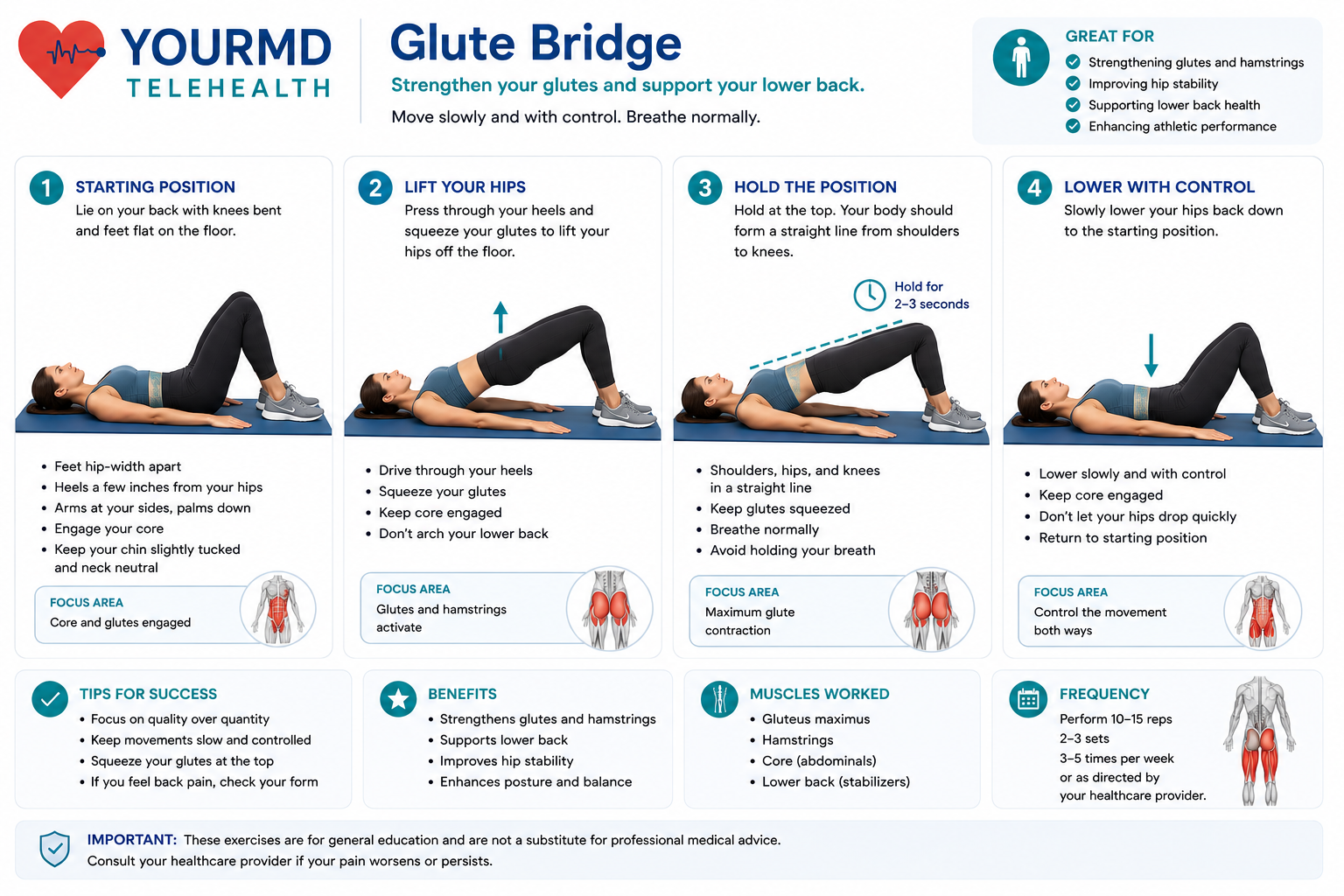
Benefits of the Glute Bridge
When performed correctly, the glute bridge may help strengthen the gluteal muscles, improve core stability, support the lower back during daily activities, improve hip strength, enhance pelvic stability, reduce strain on the lumbar spine, improve posture, and build a foundation for more advanced strengthening exercises. For many people, stronger glutes translate into better movement mechanics and less stress on the lower back.
What Muscles Does the Glute Bridge Work?
Gluteus maximus — the primary muscle responsible for extending your hips during walking, climbing stairs, and standing. Gluteus medius — helps stabilize the pelvis during movement and supports balance. Hamstrings — assist with hip extension and help control movement. Core muscles — your abdominal muscles stabilize your spine throughout the exercise. Spinal stabilizers — small muscles along the spine help maintain proper alignment while you lift and lower your hips.
Who May Benefit?
The glute bridge is commonly recommended for people with chronic lower back pain, weak glute muscles, core weakness, hip weakness, prolonged sitting during the day, recovery after a back strain, and reduced pelvic stability. It is also widely used by athletes to improve performance and reduce injury risk.
When Should You Avoid This Exercise?
Stop the exercise and contact your healthcare provider if it causes sharp lower back pain, pain that radiates farther down your leg, increasing numbness, new weakness, significant hip pain, or dizziness or lightheadedness.
Seek medical evaluation before beginning if you have a recent spinal fracture, recent hip or spinal surgery without clearance, severe osteoporosis with new pain, loss of bowel or bladder control, or numbness around the groin or saddle area.
Starting Position
- Lie on your back.
- Bend both knees and place your feet flat on the floor.
- Position your feet about hip-width apart.
- Rest your arms comfortably at your sides.
- Keep your head and shoulders relaxed.
Your heels should be close enough that you can nearly touch them with your fingertips.
Step-by-Step Instructions
Step 1: Brace your core
Before lifting, gently tighten your abdominal muscles — imagine preparing for someone to lightly poke your stomach. Avoid holding your breath.
Step 2: Press through your heels
Push your heels into the floor rather than your toes. Driving through your heels encourages your glute muscles to do most of the work.
Step 3: Lift your hips
Slowly raise your hips off the floor until your shoulders, hips, and knees form a relatively straight line. Avoid arching your lower back — the movement should come from your hips, not your spine.
Step 4: Squeeze your glutes
At the top of the movement, tighten your glute muscles, hold for 3 to 5 seconds, and continue breathing normally. You should feel the effort primarily in your buttocks and the backs of your thighs.
Step 5: Lower slowly
Lower your hips under control until they gently touch the floor. Avoid dropping quickly.
Step 6: Repeat
Perform 10 to 15 repetitions, 1 to 3 sets, resting briefly between sets.
Breathing During the Exercise
A simple pattern: exhale as you lift your hips, inhale as you lower them. Avoid holding your breath throughout the exercise.
Common Mistakes to Avoid
- Arching your lower back. Once your shoulders, hips, and knees are aligned, there is no need to continue lifting. Excessive arching places unnecessary stress on the lower back.
- Pushing through your toes. This shifts the workload away from your glutes — press firmly through your heels.
- Letting your knees collapse inward. Keep your knees aligned with your hips and feet, gently pushing them outward if needed.
- Holding your breath.
- Moving too quickly. Slow, controlled repetitions improve muscle activation.
Easier Modifications
If the standard glute bridge feels difficult: lift only partway and gradually increase the range of motion over time; hold for only one or two seconds; or start with 5–8 repetitions and build up as your strength improves.
More Challenging Progressions
Once the standard glute bridge becomes easy, you may progress by holding each repetition for 10 seconds, performing additional repetitions, placing a resistance band around your thighs, elevating your feet on a stable platform, or performing a single-leg glute bridge (only after mastering the standard version). Progress gradually while maintaining excellent technique.
Can the Glute Bridge Help Sciatica?
Sometimes. If weak hip and core muscles contribute to your symptoms, strengthening these muscles may improve spinal support. However, if lifting your hips increases leg pain, numbness, or tingling, stop the exercise and consult your healthcare provider.
Can Older Adults Perform Glute Bridges?
Yes. The glute bridge is an excellent exercise for many older adults because it helps maintain hip strength, balance, walking ability, and functional independence. Modifications can make the exercise more comfortable if needed.
How Often Should You Do Glute Bridges?
For most people: 2 to 3 sessions per week, 1 to 3 sets, 10 to 15 repetitions. Allow at least one day of recovery between strengthening sessions. Walking and stretching can usually be performed on the days between strengthening workouts.
Frequently Asked Questions
Where should I feel this exercise?
Most people feel the exercise primarily in their glute muscles and hamstrings. You may also notice your abdominal muscles working to stabilize your body.
Should I feel pain in my lower back?
No. Mild muscle fatigue is expected, but lower back pain usually indicates poor technique or that the exercise may not be appropriate for your condition.
Can glute bridges help improve posture?
Yes. Strengthening the glutes and core helps support proper pelvic alignment, which can contribute to better posture during standing and walking.
How long does it take to get stronger?
Many people notice improvements in strength after several weeks of consistent exercise, although progress varies depending on fitness level, health conditions, and how often you exercise.
When Should You Contact Your Healthcare Provider?
Contact your healthcare provider if the exercise consistently worsens your symptoms, you develop numbness or tingling, pain begins radiating farther down your leg, you notice weakness, or your back pain continues despite regular exercise. A physical therapist can help determine whether modifications or alternative exercises are appropriate.
Seek Immediate Medical Care If
Seek emergency medical attention immediately if you develop loss of bowel or bladder control, numbness around the groin or saddle area, significant weakness in one or both legs, severe back pain after major trauma, fever or chills associated with severe back pain, or sudden severe back pain accompanied by abdominal pain, dizziness, or fainting.
The Bottom Line
The glute bridge is one of the best exercises for strengthening the muscles that support your lower back. By improving the strength of your glutes, core, and hips, it helps reduce stress on the spine and promotes healthier movement during everyday activities.
Focus on slow, controlled movements, proper breathing, and good technique rather than lifting your hips as high as possible. When combined with walking, stretching, and other strengthening exercises, the glute bridge can play an important role in reducing lower back pain and preventing future episodes.