
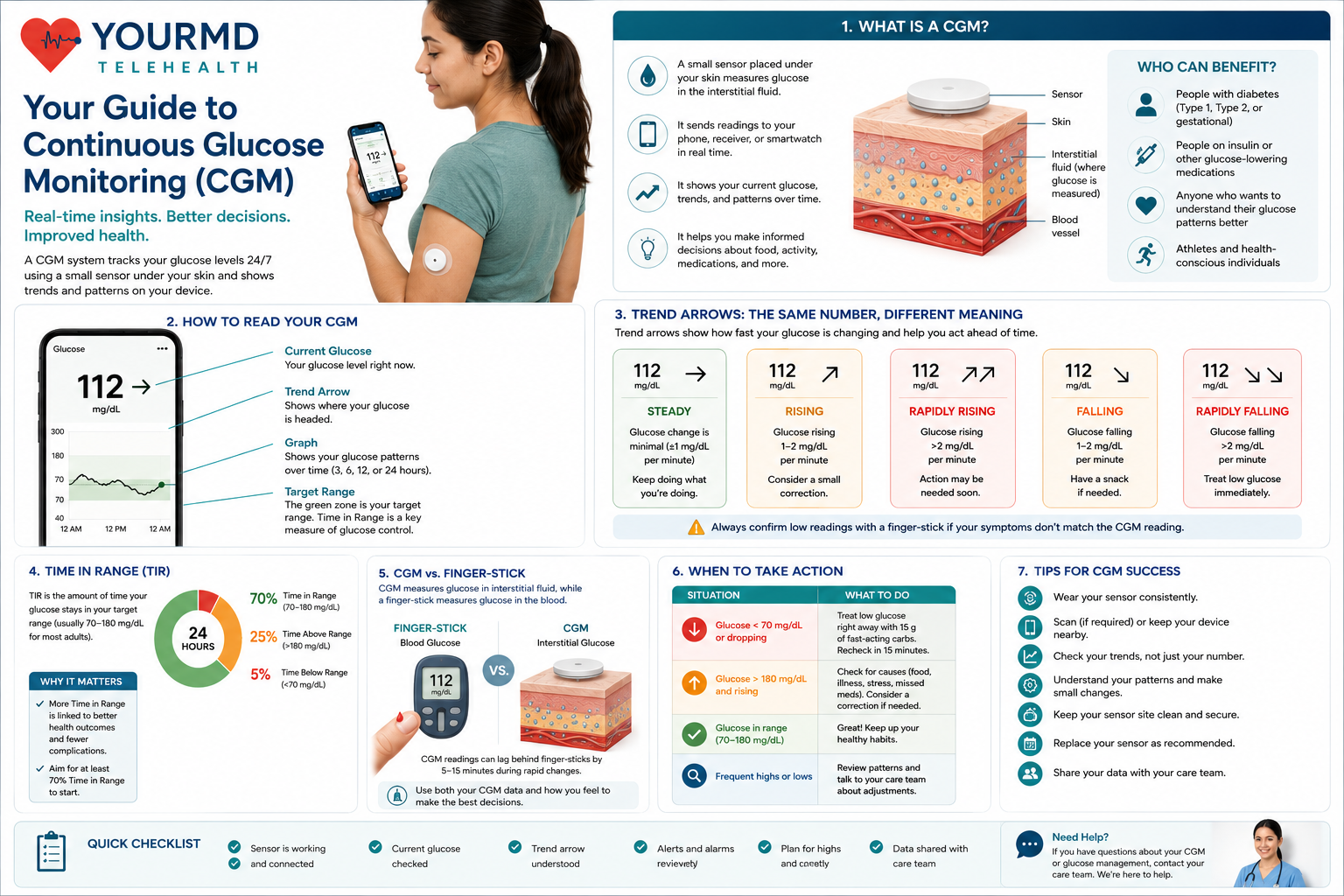
If you use a continuous glucose monitor (CGM), you've probably seen a number called Time in Range, often abbreviated TIR.
Many people focus on individual glucose readings throughout the day, but healthcare providers often pay even closer attention to Time in Range. Why? Because diabetes is about more than one glucose value. What matters most is how your glucose behaves over hours, days, and weeks.
Time in Range provides a simple way to understand how often your glucose stays within your target range and can offer a clearer picture of your day-to-day diabetes management.
What Does Time in Range Mean?
Time in Range is the percentage of time your glucose stays within your individualized target range.
Instead of asking "What is my glucose right now?", Time in Range asks: "How much of the day am I spending where I want my glucose to be?"
Since a CGM measures glucose throughout the day and night, it can estimate how much time your glucose remains within your target range.
What Is a Target Range?
Your target range is the glucose range that you and your healthcare provider have chosen based on your health, type of diabetes, age, pregnancy status, medications, and other individual factors.
Many adults with diabetes use a standard target range, but there is no single target that is appropriate for everyone. Target ranges may differ for people with type 1 diabetes, people with type 2 diabetes, older adults, children, pregnant individuals, and people who experience frequent hypoglycemia. Always use the goals recommended by your healthcare provider.
Why Is Time in Range Helpful?
Imagine two people who both have an average glucose of 150 mg/dL. At first glance, their diabetes control might seem similar. However, one person's glucose remains relatively steady all day, while the other experiences frequent highs and lows that average out to the same number.
Time in Range helps reveal these differences. It provides information that a single glucose reading—or even an average glucose value—cannot.
More Than Just Average Glucose
Average glucose tells you where your glucose has been overall. Time in Range tells you how consistently you stay within your target range.
Two people can have identical average glucose levels but very different daily experiences: one may have stable glucose, while another experiences repeated episodes of hypoglycemia and hyperglycemia. This is one reason healthcare providers increasingly use CGM reports when reviewing diabetes management.
Time Above Range and Time Below Range
Most CGM reports also show:
- Time Above Range (TAR): the percentage of time your glucose is above your target range.
- Time Below Range (TBR): the percentage of time your glucose is below your target range.
These measurements help identify patterns that may require attention. Frequent Time Above Range may suggest recurring high glucose after meals or at certain times of day, while frequent Time Below Range may indicate an increased risk of hypoglycemia. Your healthcare provider can help interpret these patterns and determine whether any treatment changes are needed.
Small Improvements Matter
One of the most encouraging aspects of Time in Range is that even modest improvements can reflect meaningful progress. You don't have to achieve perfect glucose control overnight. Instead, focus on steady improvement over time.
For example, you might notice more time within your target range after eating balanced meals, fewer overnight lows after adjusting your routine with your healthcare provider, or more stable glucose with regular physical activity. These gradual improvements are often more meaningful than individual glucose readings.
Don't Chase a Perfect Score
It's natural to want your Time in Range to be as high as possible. However, diabetes management is not about perfection. Everyone experiences illness, stress, holidays, travel, changes in routine, and unexpected glucose fluctuations.
A temporary decrease in Time in Range does not mean you have failed. Instead, use it as an opportunity to learn what may have influenced your glucose.
How Can You Improve Time in Range?
Improving Time in Range often involves small, consistent habits rather than dramatic changes. These may include:
- Taking medications as prescribed.
- Eating balanced meals.
- Staying physically active.
- Reviewing CGM trends.
- Keeping follow-up appointments.
- Learning how meals affect your glucose.
- Recognizing patterns rather than isolated readings.
Avoid making medication adjustments on your own unless instructed by your healthcare provider.
Review Trends Over Days, Not Hours
One afternoon with higher glucose should not be the basis for major treatment decisions. Instead, review your CGM reports over several days or weeks. Ask questions such as: Are my mornings consistently higher? Do certain meals cause repeated glucose spikes? Am I having overnight lows? Has my Time in Range improved since my last visit?
Looking at longer-term patterns provides much more useful information.
Time in Range and A1C
Time in Range and A1C both provide valuable information, but they measure different aspects of diabetes management. A1C estimates your average glucose over approximately three months. Time in Range shows how often your glucose stays within your target range each day.
Using both together gives your healthcare provider a more complete understanding of your diabetes.
Frequently Asked Questions
Is Time in Range more important than my current glucose?
They serve different purposes. Your current glucose helps you make immediate decisions. Time in Range helps evaluate your overall diabetes management over time.
What is a good Time in Range?
There is no single goal that is appropriate for everyone. Your healthcare provider will recommend a target based on your individual health and diabetes management plan.
Can Time in Range improve before my A1C changes?
Yes. Because CGM data is available immediately, improvements in Time in Range may become apparent well before your next A1C test.
Should I check my Time in Range every day?
Many people find it more useful to review Time in Range over several days or weeks rather than focusing on daily changes. Longer periods provide a more accurate picture of your overall glucose patterns.
When Should You Contact Your Healthcare Provider?
Schedule a follow-up if your Time in Range has decreased significantly, you're experiencing frequent low glucose episodes, your glucose remains above your target range for extended periods, you're unsure how to interpret your CGM report, or you have questions about your diabetes treatment plan.
Reviewing your CGM data together can help identify opportunities to improve glucose management safely.
The Bottom Line
Time in Range is one of the most valuable measurements provided by a continuous glucose monitor. Rather than focusing on individual glucose readings, it shows how consistently your glucose remains within your target range throughout the day and night.
By looking for long-term patterns instead of reacting to every number, Time in Range can help you better understand your diabetes and work with your healthcare provider to make informed decisions about your care.