
Continuous glucose monitors (CGMs) have changed how many people manage diabetes. Instead of checking your blood sugar with occasional finger-stick tests, a CGM provides a nearly continuous stream of glucose information throughout the day and night.
For many people, seeing hundreds of glucose readings each day can feel overwhelming at first. The good news is that you do not need to interpret every number individually. The real value of a CGM comes from recognizing patterns and trends over time rather than reacting to every fluctuation.
This guide explains what your CGM is measuring, what the numbers mean, and how to use the information to better understand your diabetes.
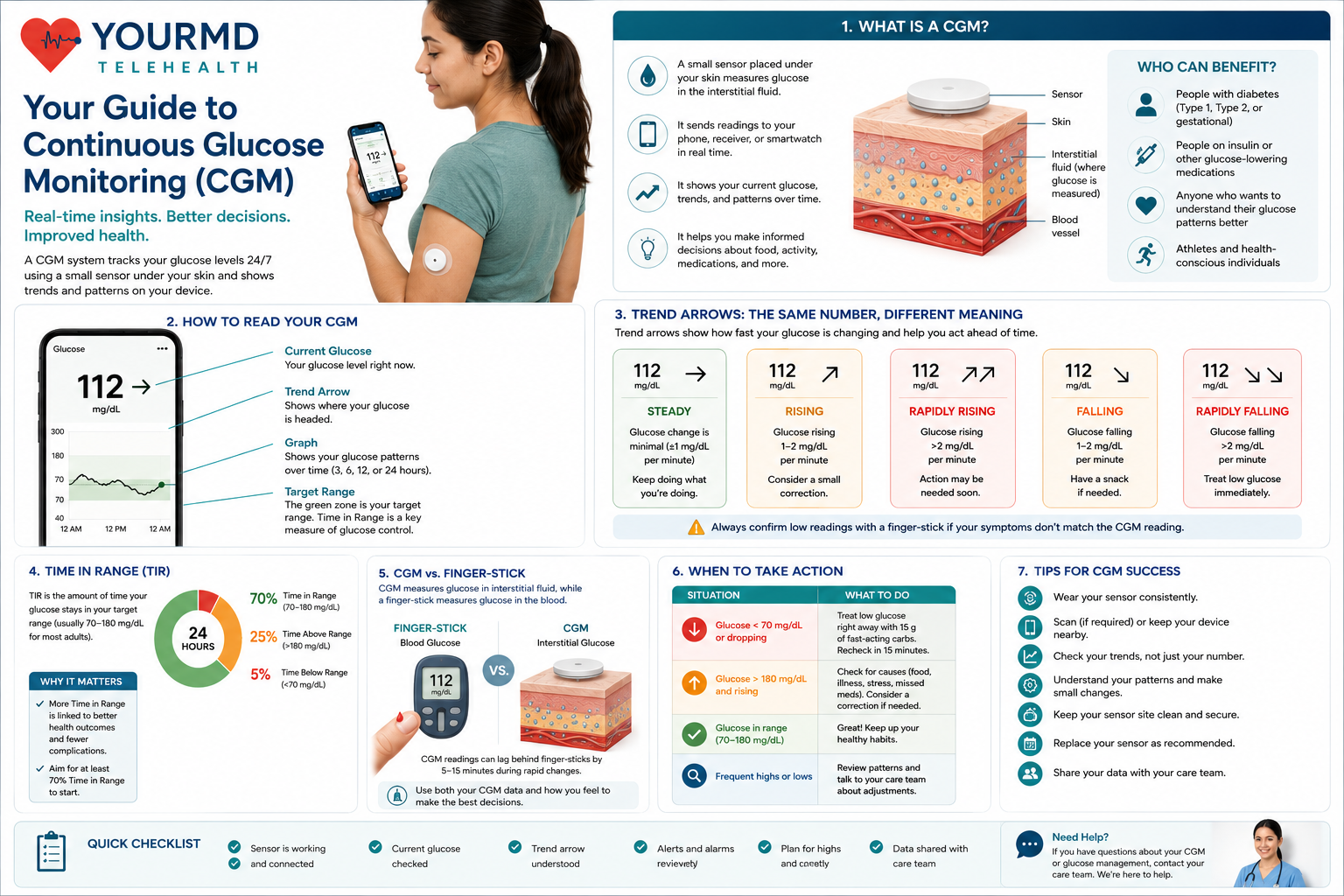
What Does a CGM Measure?
A CGM does not measure blood sugar directly. Instead, the sensor measures glucose in the interstitial fluid, the fluid that surrounds your body's cells.
Because glucose moves from the bloodstream into this fluid, CGM readings usually reflect your glucose level very closely, but they may lag behind blood glucose by several minutes—especially when glucose is changing rapidly. This small delay is expected and is one reason CGM readings and finger-stick glucose readings are not always identical.
What You'll See on Your Screen
Most CGM systems display four key pieces of information:
- Your current glucose value
- A trend arrow
- A graph showing recent glucose history
- Alerts for high or low glucose (if enabled)
Learning to interpret all four together provides much more useful information than looking at the current glucose value alone.
Understanding Your Current Glucose Reading
The number displayed on your CGM represents your estimated glucose level at that moment. By itself, however, that number tells only part of the story.
A glucose value of 110 mg/dL may be stable, rising quickly, or falling quickly — and those situations require different decisions. That is why the trend arrow and recent graph are just as important as the glucose number itself.
The Importance of Trend Arrows
Trend arrows indicate whether your glucose is staying relatively stable, rising, rising rapidly, falling, or falling rapidly. Rather than focusing only on where your glucose is now, trend arrows help you understand where it is likely heading over the next several minutes.
For example, a glucose of 95 mg/dL with a downward trend deserves different attention than 95 mg/dL with a stable trend. Understanding trend arrows helps you make safer decisions about meals, exercise, and treating low blood sugar. We cover this in depth in our guide to CGM trend arrows.
Look for Patterns, Not Individual Numbers
One of the biggest mistakes new CGM users make is worrying about every glucose change. Glucose naturally rises and falls throughout the day.
Instead of asking "Why did my glucose go from 108 to 122?", ask:
- What happens after breakfast?
- What happens after exercise?
- What happens overnight?
- Do certain meals consistently raise my glucose?
- Am I spending most of the day in my target range?
Patterns are much more useful than isolated readings.
Your Daily Glucose Graph
Your CGM graph shows how glucose changes over time. Looking at the graph may help you identify morning glucose patterns, meal-related glucose rises, overnight lows, exercise-related changes, and repeated highs after certain foods.
Over days and weeks, these patterns become valuable information that you can review with your healthcare team.
Why Glucose Changes Throughout the Day
Glucose is constantly changing. Many factors influence your readings, including meals, physical activity, insulin, other diabetes medications, illness, stress, sleep, and hormonal changes. Seeing these changes is one of the greatest advantages of using a CGM.
Don't Panic Over Every High or Low
Everyone experiences occasional glucose highs and lows. One elevated reading does not mean your diabetes is out of control. Likewise, one lower reading does not necessarily indicate a serious problem.
Instead, pay attention to how often highs occur, how long they last, whether lows happen repeatedly, and overall glucose patterns over several days. Your healthcare provider is usually much more interested in these trends than in a single isolated number.
What Is "Time in Range"?
Many CGM systems report the percentage of time your glucose remains within your target range. This measurement is called Time in Range (TIR).
For many people, Time in Range provides a better picture of day-to-day glucose control than looking at individual readings alone. Your healthcare provider can help determine the target range that is appropriate for you.
When Should You Check With a Finger-Stick?
Although CGMs are highly accurate, there are situations when a glucose meter may provide important additional information. Consider confirming your glucose with a finger-stick if:
- Your symptoms do not match your CGM reading.
- Your CGM displays an unexpected value.
- You receive an error message.
- Your healthcare provider has instructed you to confirm certain readings.
Always follow the recommendations provided for your specific CGM system. See our full guide on when to confirm a CGM reading with a glucose meter.
Common Mistakes New CGM Users Make
Many people are surprised to learn that using a CGM involves a learning curve. Common mistakes include checking the app every few minutes, reacting to every glucose change, ignoring trend arrows, comparing every reading with someone else's, and becoming discouraged by temporary highs.
Remember that diabetes management is about long-term patterns, not perfection.
Frequently Asked Questions
Is my glucose supposed to stay at one number?
No. Glucose naturally rises and falls throughout the day in response to meals, activity, stress, medications, sleep, and many other factors. Some variability is completely normal.
Which is more important—the glucose number or the trend arrow?
Both are important. The glucose number tells you where you are now, while the trend arrow helps show where your glucose is heading. Looking at both together provides a more complete picture.
Why does my glucose rise after eating?
After meals, carbohydrates are broken down into glucose, causing blood sugar to rise. The size and timing of that increase depend on many factors, including the type of food you eat, your medications, and your body's insulin response.
Should I check my CGM constantly?
Probably not. Many people benefit from checking their CGM at routine times—such as before meals, before driving, before exercise, at bedtime, or when they receive an alert—rather than monitoring every small change throughout the day.
When Should You Contact Your Healthcare Provider?
Contact your healthcare provider if your glucose readings are consistently higher or lower than expected, you're having repeated episodes of low blood sugar, your CGM readings frequently do not match your symptoms, you are unsure how to interpret your glucose patterns, or you need help adjusting your diabetes management plan.
Reviewing your CGM data together can often identify patterns that lead to meaningful improvements.
The Bottom Line
A continuous glucose monitor provides much more than a single blood sugar reading—it offers a window into how your glucose changes throughout the day.
Rather than focusing on individual numbers, look for patterns, pay attention to trend arrows, and use the information to better understand how food, exercise, medications, illness, and daily routines affect your diabetes. Learning to interpret your CGM takes time, but it is one of the most valuable skills you can develop for managing diabetes with confidence.