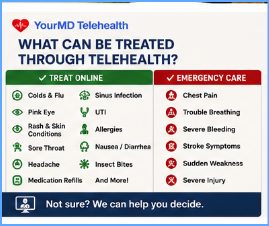

Telehealth has changed the way millions of Americans receive healthcare. What was once considered an alternative during the COVID-19 pandemic has become an essential part of modern medical practice. Still, one question comes up repeatedly: “Can this be treated through telehealth?”
The answer depends on your symptoms, your medical history, and whether a physical examination or diagnostic testing is necessary. Many common conditions can be evaluated through a secure online consultation. Others require an in-person examination, imaging, or emergency treatment. Understanding the difference can save time, reduce unnecessary costs, and help you receive the right care at the right time.
How Telehealth Works
A telehealth visit is much more than a quick online conversation. Just like an office visit, your physician will review your symptoms, discuss your medical history, review medications, ask about allergies, evaluate risk factors, recommend treatment, explain follow-up care, and decide whether additional testing is needed. For many conditions, this information is enough to make an accurate diagnosis; for others, telehealth serves as the first step in determining whether further evaluation is necessary.
Women’s Health Conditions
Several common women’s health concerns are particularly well suited for telehealth: urinary tract infections, yeast infections, bacterial vaginosis, and birth control refills. When appropriate, treatment can be prescribed electronically after a physician reviews your symptoms, pregnancy status, and history.
Skin Conditions
Many skin disorders are diagnosed visually, and high-quality photographs often provide valuable clinical information. Examples include adult acne (tretinoin, topical antibiotics, and other medications), cold sores (antivirals work best started early), eczema flares, contact dermatitis from soaps or plants, ringworm, and poison ivy — most of which can be diagnosed from photographs and treated without an office visit.
Respiratory Conditions
Many respiratory illnesses begin with similar symptoms, and telehealth helps distinguish between common causes: seasonal allergies, sinus infections, common colds (supportive treatment and guidance that often prevents unnecessary antibiotics), influenza (antiviral treatment when evaluated early), and mild COVID-19 (evaluation and antiviral medications when appropriate).
Neurological Conditions
Patients with an established history of migraine frequently benefit from telehealth — rescue medications, prescription triptans, nausea medication, and preventive-therapy discussions. Patients with new neurological symptoms or warning signs require emergency evaluation.
Medication Management & Lab Review
Telehealth is excellent for discussing medication side effects, prescription refills, drug interactions, follow-up visits, and treatment adjustments. If you’ve recently completed blood work or imaging ordered by another physician, telehealth can be an efficient way to discuss your results and determine appropriate next steps.
What Telehealth Cannot Do
Although telemedicine is remarkably effective, it has limitations. Certain conditions require physical examination or specialized equipment: broken bones, deep cuts needing stitches, large abscesses, earwax or foreign-body removal, intravenous fluids, X-rays, CT scans, and ultrasound examinations. Telehealth should never replace emergency medical care.
Frequently Asked Questions
Can physicians really diagnose medical problems online?
Yes. Many diagnoses depend primarily on medical history rather than laboratory testing or physical examination. When additional testing is needed, your physician will recommend it.
Can prescriptions be sent electronically?
Yes. When clinically appropriate, prescriptions can be sent directly to your preferred pharmacy.
Will I need a video visit?
Not always. Many conditions can be evaluated through secure messaging, while others benefit from video consultation. The appropriate visit type depends on your symptoms.
Can telehealth save money?
For many patients, yes — virtual care often reduces travel expenses, missed work, childcare costs, waiting-room time, and unnecessary urgent care visits.
Conditions Commonly Managed Through YourMD Telehealth
| Condition | Telehealth? |
|---|---|
| UTI, yeast infection, BV, birth control refill | ✅ Usually appropriate |
| Seasonal allergies, sinus infection, cold sores | ✅ Usually appropriate |
| Adult acne, poison ivy, ringworm, eczema, contact dermatitis | ✅ Usually appropriate |
| Pink eye, migraine, medication refills, lab review | ✅ Usually appropriate |
| Chest pain, stroke symptoms, severe shortness of breath | ❌ Emergency care |
Why YourMD Telehealth Is Different
At YourMD Telehealth, we believe good medicine begins with listening. Every consultation is performed by a board-certified physician who carefully reviews your symptoms before recommending treatment. We do not believe every illness needs antibiotics, and we do not believe every patient needs an office visit. Most importantly, we believe patients deserve honest medical advice — even if that means recommending emergency care or referral when telehealth is not the safest option. Adults in Nevada, Washington, Oregon, and Wisconsin can choose secure messaging ($20), live physician chat ($20), phone consultation ($40), or video consultation ($50). If your condition requires in-person evaluation, we’ll explain why and help you understand your next steps. A new patient’s first consultation is $60; the visit prices above apply to established patients.
References
- American Medical Association. Digital Health Implementation Playbook.
- Agency for Healthcare Research and Quality. The Evidence Base for Telehealth.
- American College of Physicians. Telemedicine in Primary Care.
- Centers for Medicare & Medicaid Services. Telehealth Services.
- Totten AM, et al. Telehealth: Mapping the Evidence for Patient Outcomes. AHRQ.
This article is for general educational purposes and is not a substitute for individualized medical advice. Prescriptions are provided only when a physician determines treatment is clinically appropriate. Services currently available to adults 18+ in Nevada, Washington, Oregon, and Wisconsin.