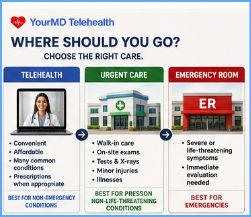

Twenty years ago, if you woke up with a urinary tract infection, sinus pressure, or a rash, you had two choices: wait for your primary care physician or spend several hours at an urgent care clinic. Today, telehealth has changed how many common medical problems are treated.
Virtual care offers timely access to a physician without the inconvenience of travel, crowded waiting rooms, or taking an entire afternoon off work. At the same time, telehealth is not appropriate for every medical problem — some conditions require a hands-on examination, laboratory testing, imaging studies, or emergency treatment. Knowing when telehealth is the right choice can help you receive appropriate care faster while avoiding unnecessary visits and healthcare costs.
What Is Telehealth?
Telehealth allows patients to consult with a licensed physician using secure technology instead of visiting a medical office — through secure messaging, telephone consultations, video visits, secure photo uploads, electronic prescriptions, and follow-up care. Modern telehealth is not simply texting with a provider. It is a structured medical evaluation that includes history-taking, medical decision-making, diagnosis when appropriate, treatment recommendations, and documentation.
What Is Urgent Care?
Urgent care clinics provide same-day treatment for illnesses and injuries that are not emergencies but require in-person evaluation — minor fractures, lacerations requiring stitches, sprains, ear infections requiring examination, asthma exacerbations, minor burns, and dehydration requiring intravenous fluids. Urgent care fills the gap between primary care and emergency medicine.
Advantages of Telehealth
For many common conditions, telehealth offers faster access (many visits completed the same day), convenience (no driving, parking, waiting rooms, or time away from work), lower cost (often less than an urgent care visit, plus fewer indirect costs), and reduced exposure to illness (waiting rooms frequently contain patients with influenza, COVID-19, and RSV).
Conditions That Are Excellent for Telehealth
Many common illnesses can be evaluated without a physical examination, including urinary tract infections, yeast infections, bacterial vaginosis, birth control refills, seasonal allergies, migraine headaches, cold sores, adult acne, pink eye, and medication questions.
When Urgent Care Is Usually Better
Some conditions require direct examination or equipment not available through telemedicine: deep cuts, suspected fractures, severe ear pain requiring examination, persistent high fever, abscesses that may require drainage, severe dehydration, eye injuries, and severe burns.
Can Telehealth Prescribe Medication?
Yes. If your physician determines that prescription medication is appropriate, it can often be sent electronically to your pharmacy — antibiotics for appropriate bacterial infections, antifungals, migraine medications, allergy medications, birth control, acne medications, and antivirals. However, responsible physicians do not prescribe medications simply because they are requested; treatment recommendations are always based on the diagnosis and current guidelines.
What If the Doctor Decides You Need to Be Seen?
One of the strengths of telehealth is recognizing its own limitations. During your consultation, your physician may determine that you need laboratory testing, imaging, a physical examination, emergency treatment, or a specialist referral. This does not mean the visit was unsuccessful — it means the physician identified the safest next step based on your symptoms.
Telehealth vs. Urgent Care vs. Emergency Room at a Glance
| Situation | Telehealth | Urgent Care | ER |
|---|---|---|---|
| UTI symptoms | ✅ | ✅ | — |
| Yeast infection | ✅ | ✅ | — |
| Birth control refill | ✅ | — | — |
| Seasonal allergies | ✅ | Sometimes | — |
| Migraine without warning signs | ✅ | Sometimes | — |
| Acne / pink eye | ✅ | Sometimes | — |
| Deep cut requiring stitches / broken bone | — | ✅ | Sometimes |
| Chest pain / stroke symptoms / severe breathing difficulty | — | — | ✅ |
Frequently Asked Questions
Is telehealth as good as seeing a doctor in person?
For many uncomplicated conditions, studies have shown telehealth provides safe and effective care with high patient satisfaction. However, some conditions still require physical examination or testing.
Can I use telehealth if I’ve never been seen before?
Yes. Many patients establish care through telehealth for common medical concerns.
What if I need laboratory work?
Your physician can recommend laboratory testing when appropriate and explain why it is needed.
Will insurance cover telehealth?
Coverage varies by plan. Many patients also choose affordable self-pay telehealth for transparent pricing and faster access.
How YourMD Telehealth Can Help
At YourMD Telehealth, we believe patients deserve access to thoughtful medical care without unnecessary delays. Our board-certified physicians provide evidence-based care for many common concerns while recognizing when in-person evaluation is necessary. Adults in Nevada, Washington, Oregon, and Wisconsin can choose secure messaging ($20), live physician chat ($20), phone consultation ($40), or video visit ($50). If your condition can be safely treated online, we’ll help you get started quickly; if you need additional testing or emergency care, we’ll explain why and guide you to the appropriate next step. A new patient’s first consultation is $60; the visit prices above apply to established patients.
References
- American College of Physicians. Telemedicine in Primary Care: Clinical Guidance.
- American Medical Association. Digital Health Implementation Playbook.
- Agency for Healthcare Research and Quality (AHRQ). The Evidence Base for Telehealth.
- Centers for Medicare & Medicaid Services. Telehealth Services Overview.
- Totten AM, et al. Telehealth: Mapping the Evidence for Patient Outcomes. AHRQ Comparative Effectiveness Review.
This article is for general educational purposes and is not a substitute for individualized medical advice. Prescriptions are provided only when a physician determines treatment is clinically appropriate. Services currently available to adults 18+ in Nevada, Washington, Oregon, and Wisconsin.