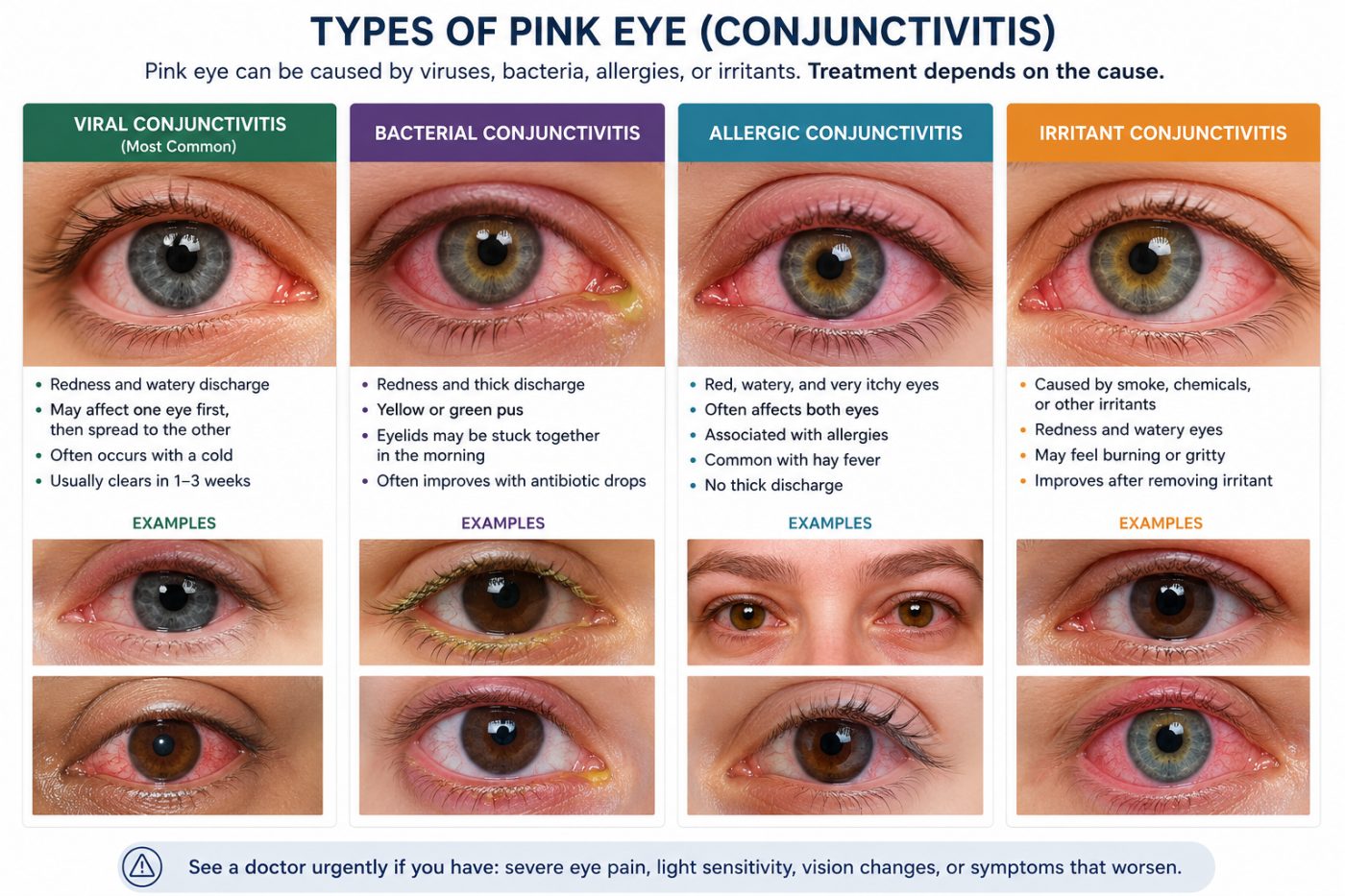

Few conditions spread as quickly through families, schools, and workplaces as pink eye. One child comes home from school rubbing an eye, and within days several family members have redness, tearing, and irritation.
Despite how common conjunctivitis is, many people immediately assume they need antibiotic eye drops. In reality, most cases of pink eye are not bacterial and do not improve with antibiotics. Understanding what causes conjunctivitis helps patients receive the right treatment while avoiding unnecessary medications. Many uncomplicated cases can be evaluated through telehealth, allowing patients to receive timely medical advice without exposing others in a waiting room.
What Is Pink Eye?
Pink eye, medically called conjunctivitis, is inflammation of the conjunctiva — the thin transparent membrane covering the white part of the eye and the inside of the eyelids. When it becomes inflamed, blood vessels enlarge, giving the eye its characteristic pink or red appearance. Conjunctivitis has many causes: viruses, bacteria, allergies, chemical irritants, and foreign bodies. Treatment depends entirely on the underlying cause.
Viral Pink Eye
Viral conjunctivitis is the most common type and often develops alongside common colds, COVID-19, influenza, and other upper respiratory infections. Symptoms usually include red eye, watery discharge, mild burning, light sensitivity, swollen eyelids, and one eye affected first, then the other. Because viruses cause the infection, antibiotics do not help. Most viral conjunctivitis improves within one to three weeks.
Bacterial Pink Eye
Bacterial conjunctivitis is less common but still frequently seen. Typical symptoms include thick yellow or green discharge, eyelids stuck together upon waking, redness, mild irritation, and crusting around the eyelashes. Unlike viral conjunctivitis, bacterial infections may improve more quickly with antibiotic eye drops.
Allergic Conjunctivitis
Seasonal allergies commonly affect the eyes, causing intense itching, watery eyes, redness, puffy eyelids, and both eyes affected simultaneously. Unlike infectious conjunctivitis, there is no thick pus, it is not contagious, and antibiotics are unnecessary. Treatment focuses on antihistamines and allergy control.
Viral vs. Bacterial vs. Allergic Pink Eye
| Symptom | Viral | Bacterial | Allergic |
|---|---|---|---|
| Redness | Yes | Yes | Yes |
| Thick yellow discharge | Rare | Prominent | No |
| Watery eyes | Prominent | Sometimes | Prominent |
| Itching | Mild | Mild | Intense |
| Contagious | Yes | Yes | No |
| Antibiotics helpful | No | Sometimes | No |
How Does Pink Eye Spread?
Viral and bacterial conjunctivitis spread easily through hand contact, towels, pillowcases, cosmetics, contact lenses, and respiratory droplets. Children often spread conjunctivitis rapidly because they frequently rub their eyes and touch shared surfaces. Good hand hygiene remains the most effective preventive measure.
How Physicians Diagnose Pink Eye
Most uncomplicated conjunctivitis can be diagnosed from your symptoms and photographs. Your physician may ask when symptoms began, whether one or both eyes are affected, the type of discharge, whether you have itching, whether you recently had a cold, whether you wear contact lenses, whether you have blurry vision, and whether there is significant eye pain. These questions help distinguish simple conjunctivitis from more serious eye conditions.
When Antibiotics Help
Antibiotic eye drops are appropriate only when bacterial conjunctivitis is likely — and even then, mild bacterial conjunctivitis often improves without antibiotics. Your physician considers the type of discharge, duration of symptoms, contact lens use, severity, age, and risk factors. Prescribing antibiotics for every red eye contributes to unnecessary medication use and antibiotic resistance.
Can Telehealth Treat Pink Eye?
Yes. Many uncomplicated cases of conjunctivitis are excellent candidates for telehealth. High-quality photographs combined with your medical history often allow physicians to distinguish between viral, bacterial, and allergic conjunctivitis. If your symptoms suggest a more serious eye disorder, your physician will recommend immediate in-person evaluation by an ophthalmologist or emergency department.
Frequently Asked Questions
Is pink eye always contagious?
No. Allergic conjunctivitis is not contagious. Viral and bacterial conjunctivitis usually are.
Can I go to work?
If symptoms are caused by viral or bacterial conjunctivitis, avoid close contact with others until your physician advises it is appropriate to return. Schools and employers may have specific return policies.
Should I throw away my eye makeup?
Yes. Eye makeup used during an infection may become contaminated and contribute to reinfection.
Can I wear contact lenses?
No. Do not wear contact lenses until the infection has completely resolved and your physician advises it is safe.
How YourMD Telehealth Can Help
If you wake up with a red, irritated eye, you don’t necessarily need to spend hours at an urgent care clinic. With YourMD Telehealth, adults in Nevada, Washington, Oregon, and Wisconsin can upload photographs and discuss their symptoms with a board-certified physician from home. When appropriate after your medical evaluation, secure messaging consultations start at $20, phone visits are $40, and video visits are $50, with prescription eye medications sent electronically to your preferred pharmacy if clinically indicated. If your symptoms suggest a vision-threatening condition, we will recommend immediate in-person evaluation without delay. A new patient’s first consultation is $60; the visit prices above apply to established patients.
References
- American Academy of Ophthalmology. Preferred Practice Pattern®: Conjunctivitis.
- American Academy of Family Physicians. Diagnosis and Management of Red Eye in Primary Care.
- Azari AA, Barney NP. Conjunctivitis: A Systematic Review of Diagnosis and Treatment. JAMA. 2013;310(16):1721–1729.
- Centers for Disease Control and Prevention. Conjunctivitis (Pink Eye).
- American Optometric Association. Conjunctivitis Clinical Guidelines.
This article is for general educational purposes and is not a substitute for individualized medical advice. Prescriptions are provided only when a physician determines treatment is clinically appropriate. Services currently available to adults 18+ in Nevada, Washington, Oregon, and Wisconsin.