
The prone press-up, also known as the McKenzie extension exercise, is one of the most commonly prescribed exercises for certain types of lower back pain. It is designed to gently extend the lumbar spine by bending the back backward while keeping the hips on the floor.
Unlike exercises that round the back forward, the prone press-up moves the spine into extension. For some people—particularly those whose symptoms worsen with prolonged sitting or repeated forward bending—this movement can reduce pain and improve mobility.
However, the prone press-up is not appropriate for every cause of back pain. While it may be very helpful for some people, it can worsen symptoms for others. Learning when to use this exercise—and when to avoid it—is just as important as learning the proper technique.
What Is the McKenzie Method?
The prone press-up is one exercise from the McKenzie Method of Mechanical Diagnosis and Therapy (MDT), a system developed by physical therapist Robin McKenzie. The McKenzie Method focuses on how repeated movements affect pain.
One of its key principles is centralization, meaning pain that moves out of the leg and becomes more localized in the lower back during exercise is often considered a favorable response. The prone press-up is only one component of the McKenzie Method and should not be viewed as a complete treatment program by itself.
Benefits of the Prone Press-Up
When appropriate for your condition, the prone press-up may help improve lumbar spine mobility, reduce stiffness after prolonged sitting, encourage spinal extension, improve posture awareness, reduce certain types of disc-related back pain, prepare the spine for normal daily movement, and complement a comprehensive rehabilitation program. Many people also find that the exercise temporarily reduces stiffness after long periods of desk work or driving.
Who May Benefit?
The prone press-up may help people with mechanical lower back pain, pain that worsens after prolonged sitting, stiffness after bending forward repeatedly, some cases of disc-related lower back pain, and reduced lumbar extension. It is often prescribed by physical therapists after a thorough evaluation.
Who Should Avoid This Exercise?
Stop the exercise immediately if it causes pain that travels farther down your leg, increasing numbness or tingling, new muscle weakness, sharp or severe back pain, or loss of balance.
This exercise may not be appropriate for people with certain types of spinal stenosis, some cases of spondylolisthesis, recent spinal fractures, recent spinal surgery without medical clearance, severe osteoporosis, or pregnancy after the first trimester if lying on the stomach is uncomfortable or not advised. Always follow the guidance of your healthcare provider or physical therapist if you have a specific spinal diagnosis.
Starting Position
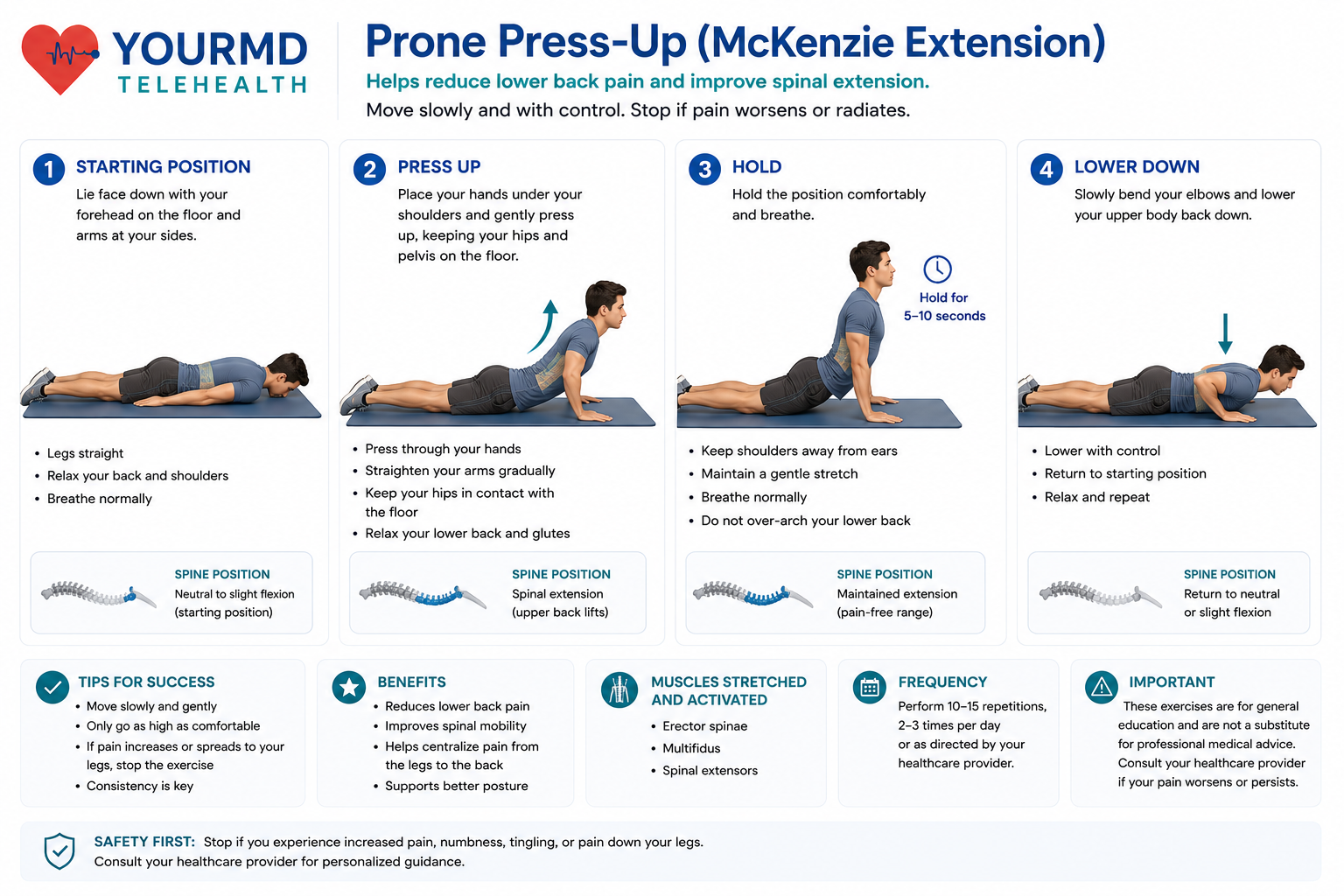
- Lie comfortably on your stomach on a firm surface.
- Extend both legs behind you and relax your hips.
- Place your palms beneath or slightly in front of your shoulders.
- Keep your elbows bent and close to your body.
- Rest your forehead or chin comfortably and take a few slow breaths.
Step-by-Step Instructions
Step 1: Relax your lower body
Allow your hips, pelvis, and legs to remain relaxed. Your hips should stay in contact with the floor throughout the movement. Avoid tightening your glutes excessively.
Step 2: Press through your hands
Slowly press into your hands, begin lifting your head and chest, and allow your elbows to straighten gradually.
Step 3: Extend only as far as comfortable
Continue pressing upward until you feel a comfortable stretch, keeping your hips on the floor. Do not force your back into excessive extension. Some people may lift only a few inches initially, while others may comfortably straighten their arms almost completely — both are acceptable if the movement remains comfortable.
Step 4: Hold briefly
Pause for 1 to 2 seconds at the top. Continue breathing normally.
Step 5: Lower slowly
Lower your chest under control until you return to the starting position.
Step 6: Repeat
Perform 10 repetitions, moving slowly and smoothly. Some rehabilitation programs recommend several sets throughout the day, but follow the recommendations of your healthcare provider or physical therapist.
What Should You Feel?
Many people notice a gentle stretch across the abdomen, mild pressure in the lower back, and improved mobility after several repetitions. The exercise should not produce sharp pain or worsening symptoms.
Understanding Centralization
One goal of the prone press-up is to encourage centralization of symptoms: pain moves out of the calf or foot, becomes limited to the thigh or buttock, and eventually centers primarily in the lower back. This response often suggests the exercise is appropriate.
The opposite response—called peripheralization—occurs when pain spreads farther down the leg. If this happens, stop the exercise and contact your healthcare provider or physical therapist.
Common Mistakes to Avoid
- Lifting your hips. Your hips should remain on the floor.
- Moving too quickly. Slow, controlled repetitions improve spinal mobility more effectively.
- Holding your breath.
- Forcing full extension. You do not need to fully straighten your elbows — work only within a comfortable range.
- Ignoring worsening leg pain. Pain that spreads farther down your leg is an important warning sign.
Easier Modifications
Start with elbow props: instead of pressing up with your hands, rest on your forearms and remain in this position for several seconds before lowering — this creates a gentler extension. Use a smaller range of motion: lift your chest only slightly and increase your range gradually as tolerated.
More Challenging Progressions
Progression should be guided by a healthcare professional and may include holding the extended position longer, increasing repetitions, incorporating standing lumbar extension exercises, and adding functional lifting and strengthening exercises. These should only be introduced if your symptoms improve.
Can the Prone Press-Up Help Sciatica?
Sometimes. The prone press-up may benefit certain people whose leg pain is related to lumbar disc irritation and improves with spinal extension. However, not all cases of sciatica respond to extension exercises. If your symptoms worsen or spread farther down your leg, discontinue the exercise and seek medical advice.
Can Older Adults Perform This Exercise?
Many older adults can safely perform modified versions. Those with limited mobility, arthritis, osteoporosis, or spinal stenosis may require a smaller range of motion or a different exercise altogether. A physical therapist can recommend the safest approach.
Frequently Asked Questions
How many repetitions should I perform?
A common starting point is 10 slow repetitions. Your healthcare provider or physical therapist may recommend a different number based on your condition.
Should I straighten my elbows completely?
Only if it remains comfortable. Some people improve with only partial extension.
Can I perform this exercise every day?
Some rehabilitation programs recommend multiple sessions per day. However, the appropriate frequency depends on your diagnosis and your response to the exercise.
Is this exercise the same as Cobra Pose?
The movements look similar. However, the prone press-up is performed as a therapeutic rehabilitation exercise with a focus on spinal mechanics rather than yoga practice.
When Should You Contact Your Healthcare Provider?
Contact your healthcare provider if the exercise consistently worsens your symptoms, pain spreads farther into your leg, you develop numbness or weakness, your back pain does not improve, or you are unsure whether this exercise is appropriate for your condition.
Seek Immediate Medical Care If
Seek emergency medical attention immediately if you develop loss of bowel or bladder control, numbness around the groin or saddle area, significant weakness in one or both legs, severe back pain after major trauma, fever or chills accompanied by severe back pain, or sudden severe back pain with abdominal pain, dizziness, or fainting.
The Bottom Line
The prone press-up, or McKenzie extension exercise, can be an effective treatment for certain types of lower back pain by improving spinal extension and encouraging healthy movement patterns. It is particularly helpful for some people whose symptoms worsen with prolonged sitting or repeated forward bending.
Because this exercise is not appropriate for every spinal condition, pay close attention to how your symptoms respond. Improvement often means pain becomes more localized to the lower back, while pain that spreads farther down the leg is a signal to stop and seek medical guidance. When combined with strengthening exercises, walking, and other mobility exercises, the prone press-up can play an important role in a comprehensive back pain rehabilitation program.