
Few symptoms create as much anxiety as discovering a new rash. It may appear overnight, itch intensely, spread across the body, or simply refuse to disappear. Many rashes look surprisingly similar, making it difficult to know whether you are dealing with an allergic reaction, an infection, eczema, or something else entirely.
While photographs on the internet can be helpful, they are rarely enough to make an accurate diagnosis. Many skin conditions overlap in appearance, and treating the wrong condition can make the problem worse — for example, using steroid cream on a fungal infection like ringworm may temporarily reduce redness while allowing the fungus to spread. This guide reviews several of the most common rashes seen in primary care and explains when telehealth may be an appropriate first step.
Quick Comparison
| Rash | Itchy | Painful | Contagious | Common Treatment |
|---|---|---|---|---|
| Eczema | High | Rare | No | Moisturizers, topical steroids |
| Ringworm | Moderate | Rare | Yes | Antifungal medication |
| Poison Ivy | High | Rare | No | Steroids, anti-itch treatment |
| Contact Dermatitis | High | Mild | No | Avoid trigger, topical steroids |
| Cellulitis | Rare | High | No | Oral antibiotics |
| Hives | High | Rare | No | Antihistamines |
| Psoriasis | Mild | Rare | No | Prescription topical therapy |
| Shingles | Sometimes | High | Yes* | Antiviral medication |
*Shingles can transmit the chickenpox virus to susceptible individuals who have never had chickenpox or the vaccine.
1. Eczema (Atopic Dermatitis)
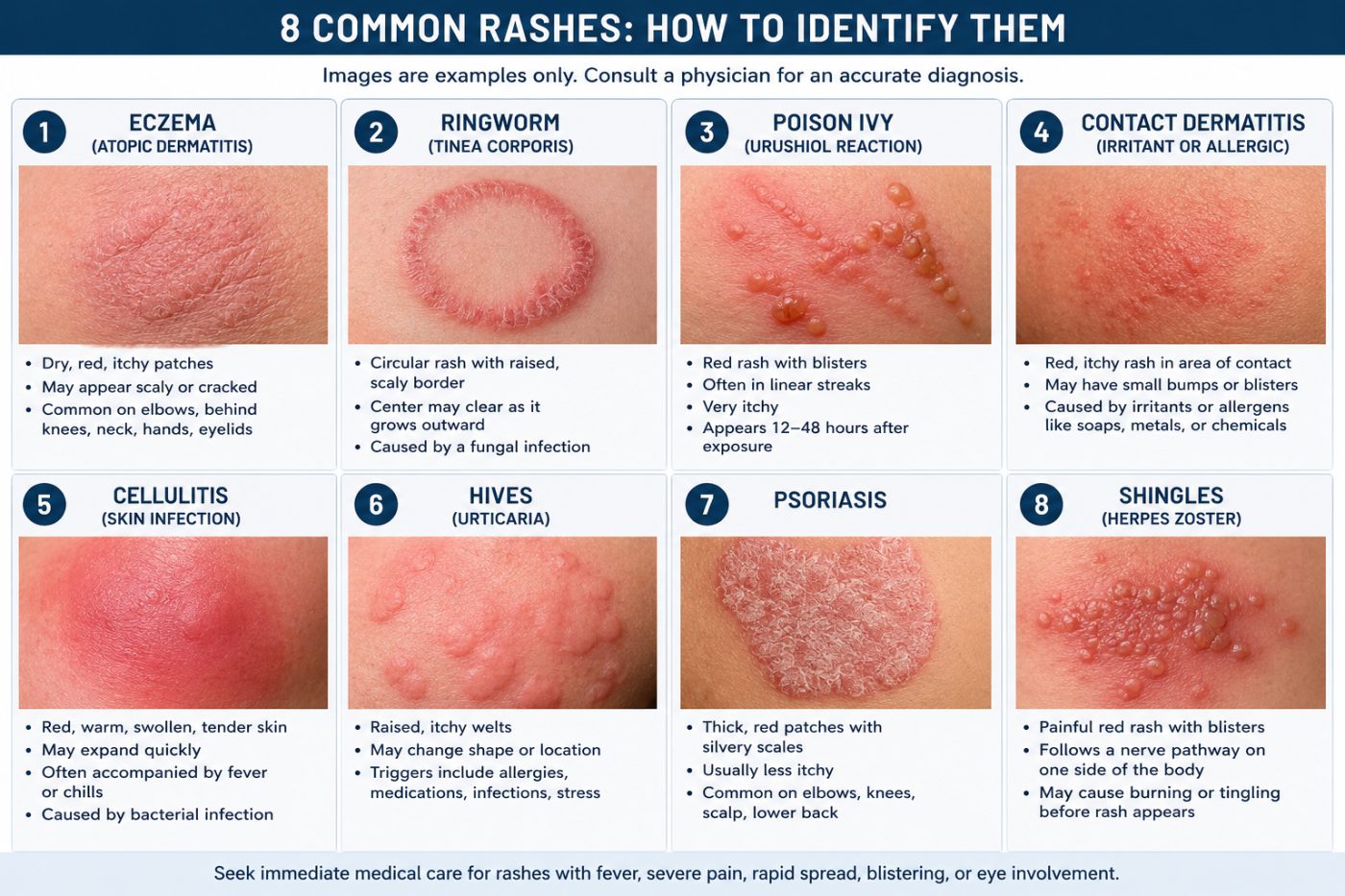
Typically dry skin, red patches, rough texture, cracking, and thickened skin from scratching — commonly on the elbows, behind the knees, hands, neck, and eyelids. The hallmark symptom is itching, often worse at night. Treatment focuses on restoring the skin barrier with moisturizers and reducing inflammation with prescription creams when necessary.
2. Ringworm (Tinea Corporis)
Despite its name, ringworm is a fungal infection: a circular rash with a raised, scaly border, central clearing, and slow enlargement, with mild to moderate itching. Steroid creams alone often make ringworm worse — treatment requires antifungal medication. Learn more about ringworm treatment.
3. Poison Ivy
Develops after contact with urushiol oil from poison ivy, oak, or sumac: a red rash, blisters, linear streaks, and swelling, with intense itching and burning. The blister fluid does not spread poison ivy — new areas appear because different parts of the skin absorbed different amounts of the plant oil. Learn more about poison ivy treatment.
4. Contact Dermatitis
Occurs when something touching the skin causes irritation or an allergic reaction — common triggers include nickel jewelry, cosmetics, soap, laundry detergent, fragrances, plants, and latex gloves. It usually produces a red rash, dry patches, and sometimes blisters that follow the area of contact. Identifying and avoiding the trigger is the most important step; prescription creams may reduce inflammation.
5. Cellulitis
A bacterial infection of the deeper layers of the skin that can become serious if untreated: bright red skin, warmth, swelling, tenderness, and expanding redness, often with pain, fever, chills, and feeling ill. Cellulitis usually hurts more than it itches and generally requires antibiotics.
6. Hives (Urticaria)
Raised welts caused by the release of histamine: smooth, raised bumps of different sizes that rapidly change shape, with severe itching. Causes include viral infections, food allergies, medications, and environmental triggers. Individual hives often disappear within 24 hours, although new ones may appear elsewhere.
7. Psoriasis
An autoimmune skin disease that causes rapid skin cell growth: thick plaques with silvery scale and well-defined borders, commonly on the elbows, knees, scalp, and lower back. Unlike eczema, psoriasis is usually less itchy but produces thicker plaques.
8. Shingles
Results from reactivation of the chickenpox virus: painful blisters on one side of the body that follow a nerve pathway, with burning pain, tingling, and sensitivity to touch. Antiviral medication works best if started within 72 hours of the rash appearing.
Can Telehealth Diagnose Skin Rashes?
Many skin conditions are excellent candidates for telehealth because physicians can combine your history with high-quality photographs. Telehealth often works well for eczema, ringworm, poison ivy, acne, cold sores, contact dermatitis, hives, and mild cellulitis (to determine if antibiotics are appropriate). Some rashes require an in-person examination, laboratory testing, or referral to a dermatologist — if that is the case, your physician will explain why.
How to Take Good Rash Photos
Good photographs help physicians make more accurate diagnoses. Use natural lighting whenever possible, keep the camera about 8–12 inches from the rash, take one close-up and one photo showing the surrounding area, avoid blurry images, do not apply heavy creams immediately before taking the photo, and include a coin or ruler nearby if the rash is small to show its size.
Frequently Asked Questions
Can a rash be diagnosed from a photo?
Many common rashes can be evaluated using high-quality photographs and your medical history. Some conditions require an in-person examination or additional testing.
Should I put antibiotic ointment on every rash?
No. Most rashes are not caused by bacterial infections. Using antibiotic ointment unnecessarily may cause skin irritation or allergic reactions.
Should I use steroid cream?
Not always. Steroid creams help eczema and contact dermatitis but can worsen untreated fungal infections such as ringworm.
Can stress cause a rash?
Yes. Stress may contribute to flare-ups of eczema, hives, psoriasis, and several other skin conditions.
How YourMD Telehealth Can Help
Skin conditions are among the most common reasons patients choose telehealth. With YourMD Telehealth, adults in Nevada, Washington, Oregon, and Wisconsin can securely upload photographs and consult with a board-certified physician from home. When appropriate after reviewing your symptoms and images, secure asynchronous consultations start at $20, live physician chat is $20, phone consultations are $40, and video visits are $50. If your rash can be safely treated online, prescriptions can be sent electronically to your preferred pharmacy; if your condition requires an in-person examination or emergency care, we’ll explain the safest next steps. A new patient’s first consultation is $60; the visit prices above apply to established patients.
References
- American Academy of Dermatology. Common Skin Conditions: Diagnosis and Treatment.
- Ely JW, Rosenfeld S, Stone MS. Diagnosis and Management of Tinea Infections. American Family Physician. 2014.
- Eichenfield LF, et al. Guidelines of Care for Atopic Dermatitis. JAAD.
- Centers for Disease Control and Prevention. Shingles (Herpes Zoster).
- Stevens DL, et al. Practice Guidelines for the Diagnosis and Management of Skin and Soft Tissue Infections. Clinical Infectious Diseases.
This article is for general educational purposes and is not a substitute for individualized medical advice. Prescriptions are provided only when a physician determines treatment is clinically appropriate. Services currently available to adults 18+ in Nevada, Washington, Oregon, and Wisconsin.